Sunday, August 11, 2013

Some Sunday Afternoon Reading..

As we wait to see if the recent bounce was an interest-rate induced pull forward of demand or a new up-leg, it is time to review our premise that we are in a bubble.

We have been over the exploding debt situation, the huge discrepancy between income, rental return and prices which is the basis for the bubble call. There is no point me reviewing them, suffice it to say we are near extremes in all these measure. Numbers which look even worse with the market driven rate rises (no action from the Bank of Canada needed), and now the CMHC pull back.

In fact since 2010, we have had a number of changes by the Federal Government designed to take RE off the boil and prices have withstood all this very well.

Will it continue or will we have a 'Wiley Coyote" moment as David Madani says.

On the other hand we have the bulls who point to places like Hong Kong, where finite supply and enormous demand from Mainland China have sent prices into the stratosphere. This is despite nearly a dozen initiatives from the HK Government trying to cool things down.

In fact they are very well documented in this excellent chart. You can click on it so that you can read the notations.


The HK government has been much more proactive about reigning in prices. Short of banning sales to Mainland Chinese, which they cannot do, they have done everything else. These include:

Forcing banks to stress test borrowers.
Dropping the loan to value to 60% for properties over about $900K (it was $1.7M before)
Increasing the property transfer tax to 4.25% for properties over $1.7M
Tightening up presales and putting penalties on both sides if they cancel.

Compared to Hong Kong, we are still in easy street, despite Mr Flaherty's changes (which were really a reversal of previous mistakes).

HK prices prices have gone up and up, pushing aside the Government road blocks like so many flies. The wall of money from China pours in through over dyke pricing out locals.

As you can see corrections were countered by the actions of another Government, Quantitative Easing by the US Fed which has poured money into the system (I won't go into how few people have benefitted from this action at this time, but will keep that for another tirade) as well as Chinese government liquidity drives (not shown) and those who can access cheap money will push up assets.

What does this tell us? That bubbles have a mind and a momentum of their own.

You will also note that Government action, even in Hong Kong, did not start until housing had increased 80% off the bottom in just a few years, and Hong Kong is one of the more sensible jurisdictions.

Government action to reign in bubbles ALWAYS comes too little and too late. When things are going up, everyone is happy and the groups benefitting the most become active in the political process to prevent any action to curtail things. It is only when it is obvious to any fool that we have entered a fantasy of valuation does Government act, usually with little effect.

Look at the graph again and you can contrast the actions of the HK government when prices started collapsing from their last bubble. Only a 30% drop brought action to bolster prices (in green). And yet they had very little effect on the way down too!

The bubble burst had to run it's course and went on and down for 5.5 years despite nearly a dozen pro-RE actions. 

Bubbles will implode when they implode. After the fact people will try and look for the cause. A particular event or action or some change in fundamentals. None of these are usually the case. It is just a case of a sudden change of mass psychology and a run for the exits.

Look at Gold the general wisdom is that Gold has been dropping due to the Fed talking about tapering QE. However if you look at the chart , you will see that the collapse started a few months BEFORE the FEd announced tapering.  

Now while I do believe the Fed's main role under Greenspan and Bernanke has been to keep profits at the Wall Street casinos healthy and some pre-warning is not unlikely, this still does not explain a drop that started due to a sudden drying up of demand. It happened because it happened.

So when our bubble bursts, we should be alert for the 'causation experts'. RE representatives, bank economists etc who will try and blame the drop on the CMHC changes or some other Government action that needs to be reversed quickly - so that we can hold them to account in public.

1) No one action leads to a bubble bursting

2) The actions of Government are always too little and too late, on the way up and down.

3) No industry has the right to jeopardize the financial well-being of a country and future generations. It is my contention (and that of many smarter than me) that the CMHC has done just that, by increasing our obligation to $600 Billion and help fan the fires of prices. The next generation has enough to contend with carrying the debt of baby-boomer entitlements without having to deal even more obligations and even more expensive housing.

Finally it is good to end with Galbraith, the pre-eminent bubble economist dissector, who was quoted in Hussman's article today

Decades ago, in his narrative A Short History of Financial Euphoria economic historian J.K. Galbraith lamented the “extreme brevity of the financial memory.” He wrote, “In consequence, financial disaster is quickly forgotten. 

In further consequence, when the same or closely similar circumstances occur again, sometimes in only a few years, they are hailed by an always supremely self-confident generation as a brilliantly innovative discovery in the financial and larger economic world. There can be few fields of human endeavor in which history counts for so little as in the world of finance. Past experience, to the extent that it is part of memory at all, is dismissed as the primitive refuge of those who do not have the insight to appreciate the incredible wonders of the present.”

(Think Nortel and RIMM shares hitting the stratosphere. Think  shoe-box sized Condos selling for $600K or crack-shacks unfit for human occupation selling for over $1 Million Dollars.)

“There is protection only in a clear perception of the characteristics common to these flights into what must conservatively be described as mass insanity. Only then is the investor warned and saved. In the short run, it will be said to be an attack, motivated by either deficient understanding or uncontrolled envy, of the wonderful process of enrichment.”

“Speculation building on itself provides its own momentum. This process, once it is recognized, is clearly evident, and especially so after the fact. So also, if more subjectively, are the basic attitudes of the participants. These take two forms. 

There are those who are persuaded that some new price-enhancing circumstance is in control, and they expect the market to stay up and go up, perhaps indefinitely. It is adjusting to a new situation, a new world of greatly, even infinitely increasing returns and resulting values. Then there are those, superficially more astute and generally fewer in number, who perceive or believe themselves to perceive the speculative mood of the moment. 

They are in to ride the upward wave; their particular genius, they are convinced, will allow them to get out before the speculation runs its course. They will get the maximum reward from the increase as it continues; they will be out before the eventual fall.

“For built into this situation is the eventual and inevitable fall. Built in also is the circumstance that it cannot come gently or gradually. When it comes, it bears the grim face of disaster. That is because both of the groups of participants in the speculative situation are programmed for sudden efforts at escape. Something, it matters little what – although it will always be much debated – triggers the ultimate reversal.”
.


Wednesday, August 7, 2013

Craft Room Makeover

I have been meaning to share my craft room. I finished it a looong time ago, but I never got around to taking pictures of it and posting about it.
I have barely set foot in here, other than working on a few things for S.R.'s Room at the beginning of the summer. Once the kids go back to school, I will have more time to work in here.

So, let me give you the tour of this walk-in-closet-turned-craft-room.
There isn't a lot of space, but it's perfect for what I am doing. 
The antique sewing machine belonged to an aunt or cousin of my mother's many moons ago...not exactly sure what her connection was. 
When I was a little girl, I used this sewing machine table as a desk to do my home work on. I can't tell you home many hours I popped that pedal up and down while working away on homework.
 The way I had the room set up before made it very difficult to stay organized. To see a before, you can go here.
I ripped out two wire shelves(FYI-they leave ENORMOUS holes in the wall), and gave the walls a fresh coat of paint.
I did a major cleansing of the craft room as well, and donated an entire van load of crafty goodness. 
Now that the clutter is gone, everything has a place, and there's some room to grow.
I needed an "idea board", and loved the look of a crib spring. It's been all over Pinterest, and I had one. Trendy and free...can't beat that!
  My main storage piece has to be my most favorite thing in the room. I had these cube shelving units, but they always ended up looking messy and disorganized. I looked online for storage bins, but they ranged from $6-$12. I needed 18 storage bins...that's a lot of money! So, I went to Target, and low and behold in the dollar section they had storage bins($3 each). I wanted all the same color, but when you're rummaging through the dollar section, one cannot be overly picky.
I found inspiration from the Land of Nod
&
With 2" wide painter's tape, number stencils, and some white fabric paint, I was able to get a similar look.
All of this for less than $60 versus $108-$216 before taxes and shipping. Not too shabby, eh?
 Another favorite in the room is the diy chalkboard. 
It is an access point into the attic, but with a little chalkboard paint, now it's actually a useful piece...I mean it was useful before..if you needed to get to the backside of the attic..but it's even more useful now, since we'll probably NEVER bust through it to get to that part of the attic:o)
I'm totally digging this new space, and it's so much easier to create in an organized environment...well it will be once I have a few minutes to myself;o)
 What are some ways that you have organized your craft space? I would love to hear!!

Tuesday, August 6, 2013

US to phase out their own catastrophic CMHC...

President Obama, arguably to the left of PM Harper, has decided to phase out Fannie Mae and Freddie Mac, their own two versions of our CMHC which insure mortgages.

Our own dithering fools in Ottawa were anti-CMHC except when it suited them. And it did in 2008/9. Even as they watched the US equivalents pull hundreds of Billions out of tax-payers pockets, they cynically doubled our own CMHC, loaded it up with a weak board (IN MY OPINION) and allowed it to have poor risk management and operate opaquely (in the opinion of Nomura and IMF and other non-Major-bank economists). 


Now hopefully they will do the right thing before this monster endangers our financial future further...and wind it down!


BTW- there was a great BNN interview with Ian Lee, an Academic who has been sounding the alarm on CMHC liability which he calls gargantuan! Says the banks are using CMHC!

Try this link.

Click on the second video 'CMHC to take stream out of housing market'. All bulls and bears should listen to this interview

Monday, August 5, 2013

The definition of a RE speculator

“In the ruin of all collapsed booms is to be found the work of men who bought property at prices they knew perfectly well were fictitious, but who were willing to pay such prices simply because they knew that some still greater fool could be depended on to take the property off their hands and leave them with a profit.” 

- Chicago Tribune, April 1890


Look at the date it was written!

This comes from the weekly post of one of my favourite commentators, John Hussman.

You can read it here. He is talking about the stock market but outlines how one bubble bursting leads to the next one inflating and the foolish actions of Central bankers who think they know better.

Saturday, August 3, 2013

Looking back and looking forward...

Time to survey the land. Where have we been and where are we headed.

We have been a raging bull market for Vancouver RE, of that there is no doubt. It started gradually with minor increases in 2000 and then went up parabolically until the crash of 2009. Then after a brief and sharp correction it went vertical and started to correct in 2012. This correction has hit buying in June and July and looks to be in jeopardy.

In 2007/8 I posted about the divergence between income and rental returns and home prices in this city, and in the US.

The financial crisis of 2008 was precipitated by the US housing bubble bursting. It brought a sharp correction to our RE. MOI went sky-high and prices dropped about 10% from late 2008 into 2009.

Us bears where vindicated. The correction we had so long waited for, was happening.

However what we didn't see was the lunacy of the Government both Provincial and Federal and the idiocy of the Bank of Canada.

The right-wing Federal Government who hates semi-socialist outfits like the Wheat Marketing Board , the CBC and the CMHC...very cynically took up the CMHC as their method of stimulating housing demand.

Even though we were witnessing the catastrophic effect on the tax-payer of the US equivalents, Freddie and Fannie going BK and needing huge infusions of money, they doubled the CMHC.

Then Carney in his wisdom brought rates down zero.

As I posted at the time, in 2009, the result of the above measures and the 10% drop in prices was to drop the monthly cost of housing 30%, which was the amount I thought housing was over-priced, and some may want to buy. Well buy they did and up went RE and it kept going up.

As it went up our equally foolish Provincial Government, hearing the cry of first time buyers, gave them financial incentives to get into the market...thereby adding fuel to the fire.

Where are we now? One of the countries with the highest personal debt levels in the world, one of the most over-valued RE in the world and a Government which calls itself fiscally prudent but which has put another $600 Billion of obligations on our shoulders through the CMHC. This is the Canadian miracle that the world has lauded!

The CMHC btw has been called opaque and having poor risk management by several organizations as we have detailed in previous posts. IMVHO this is explained by looking at the composition of the Board which lacks any RE outsiders, serious academics, well-known economists or representatives of tax-payer groups.

So bears were blind-sided by the actions of the Government. What else did we get wrong?

Income. The numbers we worked off for income in this Province, to gauge RE value, are seriously under-represented I believe. We have drug money, a huge black economy (mainly contractors and drug related), and a river of off-shore money coming here. So looking at the stated income levels was wrong.

We were wrong not to account for that in our calculations.

We were also wrong in thinking that Carney would do more than just jaw-bone as consumer debt exploded to the level that the US had pre-crisis. He refused to walk the talk.

We also did not realise how much the Federal Government would allow easy money to come here. The 'Investor's Program' in many cases has been an absolute farce and has allowed Mainland money to come here and invest in little more than commercial and residential RE, with-out the big job impact that was promised. Worse still, the entrants from almost every Province except Ontario ended up here. So Provinces like Quebec got the fiscal benefits and we got the added costs and RE pressure.

More Federal Government meddling which bears did not account for. It is hard to include the effects of Politician's constant desire 'to do something'.

OK, so where are we now?

We are in no-man's land. MOI of 6 = balanced. Some recent buying pressure after a terrible 2012 and early 2013. YOY prices still lower by a few %. Do we go up from here?

Well rates have ticked up. Mortgage rules have been tighetened. The CMHC has a new CEO and has been capped, but at too high a level IMO. 

So was this recent rush just a fear of higher rates?

If so, then it should, as I expect petter out soon and we should enter much higher MOI by late August and early September and the correction will start anew and this time it will have significant drops.

However if the buying pressure keeps up, then the correction meme has been invalidated and for now we go to higher highs. I favour the first scenario. However as we bears have learned, there is always something around the corner (usually Government meddling) which we did not account for.

There is no doubt that bear fatigue exists. Look around the blogosphere. Many blogs have closed up and I am close to throwing in the towel if scenario one does not play out. 

The subject of RE has dominated our lives for too many years in this city. Those that don't own wondering if they should abandon prudent plans and just dive in. Those who own and are deeply indebted, and have all their net worth in RE worrying if they are a job loss or re-financing away from losing it all.

This is the result of initial demand exceeding supply and absolutely stupid policies from lazy politicians and policy-makers who could only take the easy road to try and shore up consumption and demand in the economy. The power of the RE lobby cannot be underestimated.

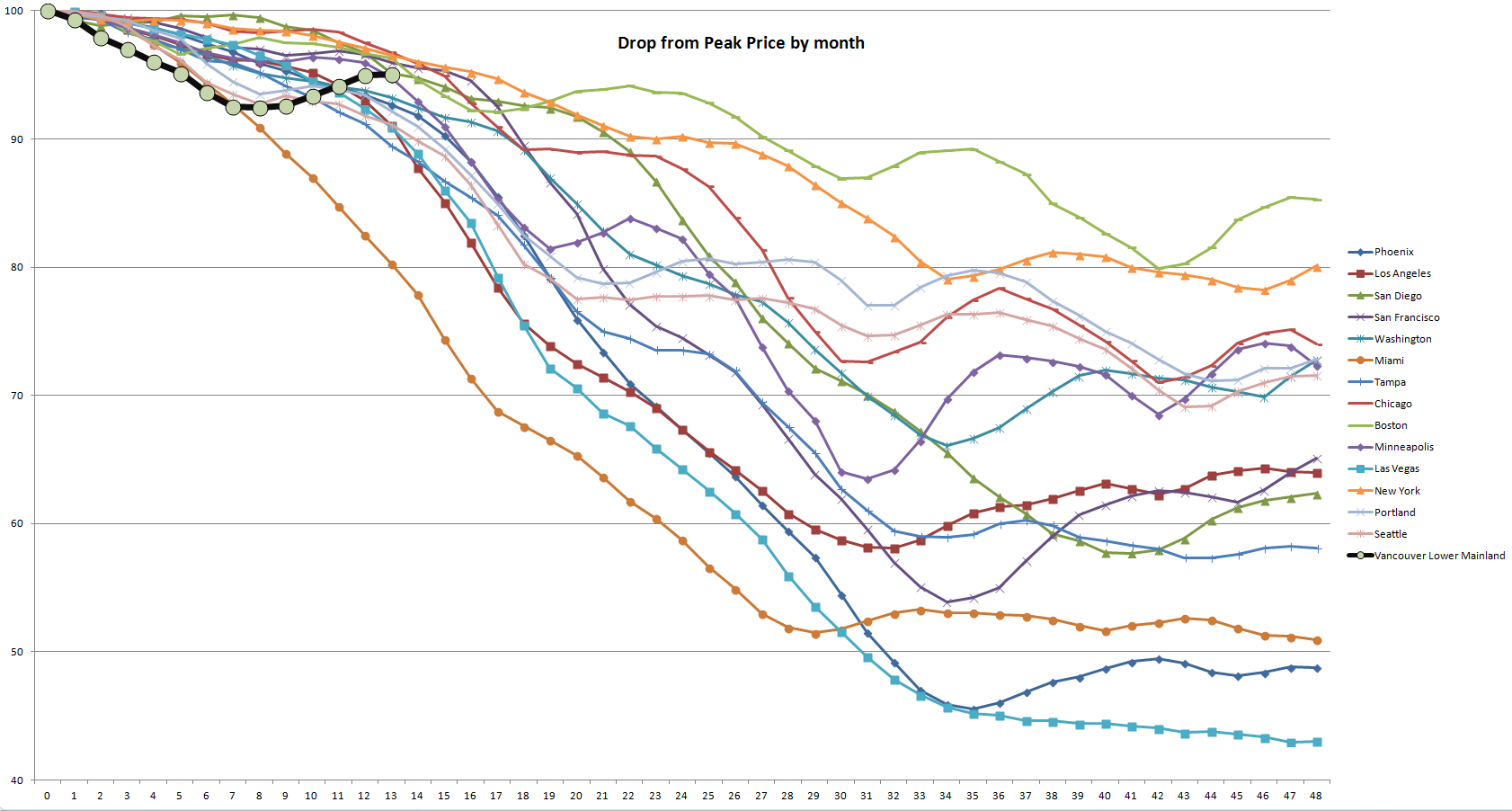
If you live in the Okanagan and Whistler you have seen major price declines and the Fraser valley is not much better, but this city has not had it's major correction yet. If we are still in a correction it has to happen soon per this graph (hat tip Price Drop Vancouver)

Have a great long week-end.


Friday, August 2, 2013

REBGV Press release

No surprises here. We all knew July was hotter in every way than we expected. Was it the post interest rate rise blip? Was it due to Chinese RE going up again, and easing of liquidity? Or are we headed up on a new up-trend?

In any case we are still down a few % YOY for HPI.

My own opinion for what it is worth (very little) is that we saw the peak of buying for the year and MOI will start going up again. We have been hovering around 6 for July. If I am right it should move up briskly, if not I am wrong.


July home sale activity increases in Greater Vancouver

Sunny weather did not slow the pace of home sale activity in July. Last month was the highest selling month of the year in Greater Vancouver and the highest selling July since 2009.
The Real Estate Board of Greater Vancouver (REBGV) reports that residential property sales in Greater Vancouver reached 2,946 on the Multiple Listing Service® (MLS®) in July 2013. This represents a 40.4 per cent increase compared to the 2,098 sales recorded in July 2012, and an 11.5 per cent increase compared to the 2,642 sales in June 2013.
Last month’s sales were 0.1 per cent above the 10-year sales average for the month.
“Demand has strengthened in our market in the last few months, which can, in part, be attributed to pent-up demand from the slowdown in sales activity we saw at the end of last year,” Sandra Wyant, REBGV president said. 
New listings for detached, attached and apartment properties in Greater Vancouver totalled 4,854 in July. This represents a 1.1 per cent increase compared to the 4,802 new listings reported in July 2012 and a 0.4 per cent decline from the 4,874 new listings in June of this year.
The total number of properties currently listed for sale on the MLS® in Greater Vancouver is 16,618, which is an 8.1 per cent decrease compared to July 2012 and a 3.9 per cent decline from June 2013.
The sales-to-active-listings ratio rose two and-a-half percentage points between June and July to 17.7 per cent in Greater Vancouver. This is the highest this ratio has been in Greater Vancouver since April 2012.
The MLS® Home Price Index composite benchmark price for all residential properties in Greater Vancouver is currently $601,900. This represents a decline of 2.3 per cent compared to this time last year and an increase of 2.3 per cent over the last six months.
“Home prices continue to experience considerable stability with minimal fluctuation throughout much of this year,” Wyant said. “This stability in price brings greater certainty to the home buying and selling process.”
Sales of detached properties reached 1,249 in July 2013, an increase of 59 per cent from the 787 detached sales recorded in July 2012, and a 13.7 per cent increase from the 1,099 units sold in July 2011. The benchmark price for detached properties decreased 3.1 per cent from July 2012 to $920,500.
Sales of apartment properties reached 1,210 in July 2013, an increase of 31 per cent compared to the 927 sales in July 2012, and an increase of 16.3 per cent compared to the 1,040 sales in July 2011. The benchmark price of an apartment property decreased 1.6 per cent from July 2012 to $368,300.
Attached property sales in July 2013 totalled 487, an increase of 27 per cent compared to the 384 sales in July 2012, and a 12.7 per cent increase from the 432 attached properties sold in July 2011. The benchmark price of an attached unit decreased 2.6 per cent between July 2012 and 2013 to $456,700. 

Friday, August 2, 2013

Sunday, July 28, 2013

Bifurcation

The market is certainly more resilient than one would expect for this time of year. There are more sales than last year as well as lower listings.

The expected rise in the MOI has yet to take place. This is in the face of a few factors which should have a dampening effect

Rates which look like they have broken out.

Mortgages changes which where brought in, in 2012 limiting CMHC insurance to $1 Million and dropping the ratio to 80% from 85%. Now in Vancouver, almost all housing would be over this threshold. But so far we have not seen much of a drop from this factor.

China was experiencing a credit tightening cycle, though it looks like they have loosened the purse strings again and reinflated their housing market (and likely ours).

On the other hand we have an up-tick in court ordered sales. We also have an up-tick in bankruptcy and arrears (hat tip aggregator on Vancouver Condo)

So where does this get us?

Is the market going up again despite the headwinds? Will the MOI drop below 6? Or is this just a pre-approval blip?

It certainly looks to me like there are two areas selling at present. One is the lower end (is there such a thing in Vancouver anymore) which would be explained by the anxious first-timers with pre-approvals in their hands. The second is upper end $3-4m where we have seen more Far East and local Wealthy buyers. Of course they would be undeterred by interest rate and other considerations.

In between, things are pretty stagnant and that may explain the drop in listings. If you see two houses like yours sitting unsold for several months, who wants to be the third one.

There is not enough financial stress out there to 'force' selling and so people will stay put and not move up or cash out. That's why paradoxially those still in the market may be more amenable to offers.

In any case July's number's are likely to be a bit of an anomaly, though I would still expect HPI to show a small decrease. 

Any opinions on what you are seeing out there would be welcome..